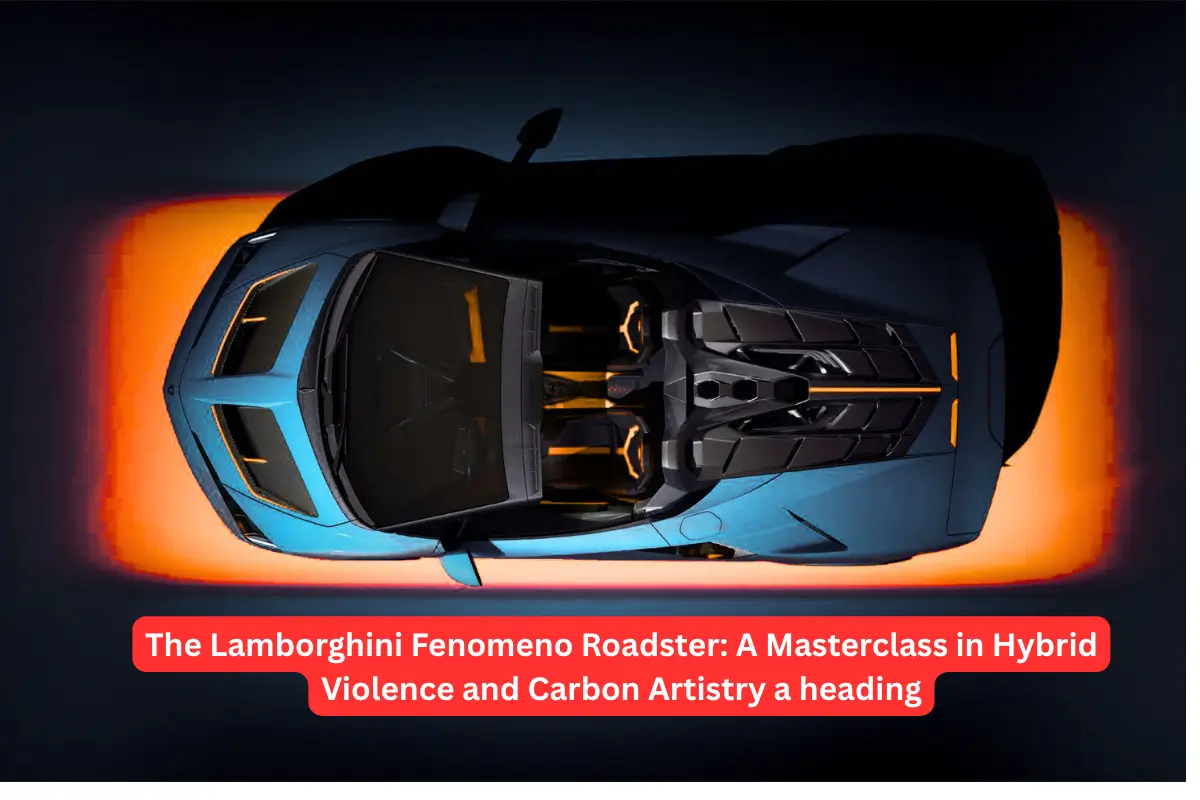
If you’ve ever wondered what it feels like to have the atmosphere physically try to peel your eyelids back while a V12 screams like a heavy metal choir behind your head, you’re looking at the answer. The Lamborghini Fenomeno Roadster isn’t just a car; it’s an existential crisis for physics. Unveiled as the final chapter of Lamborghini’s ultra-exclusive “Few-Off” series, this roofless monster is proof that Sant’Agata hasn’t lost its edge in the age of electrification.
In a world where most manufacturers are playing it safe with silent electric motors, Lamborghini decided to marry their legendary 6.5-liter naturally aspirated V12 with three electric motors. The result? A combined 1,080 cv (about 1,065 hp) of pure, unadulterated Italian fury. It is, quite literally, the most powerful open-top vehicle the brand has ever produced.
The Technical Soul: Lamborghini Fenomeno Roadster Specs
When we discuss the Lamborghini Fenomeno Roadster specs, we aren’t just looking at numbers on a spreadsheet; we are looking at the boundaries of what a road-legal car can achieve. Lamborghini has shifted from pure internal combustion to a High-Performance Electrified Vehicle (HPEV) framework, and the Fenomeno is the pinnacle of that transition.
Powertrain and Performance (Lamborghini Fenomeno Roadster)
At the heart of the beast is a mid-mounted V12 engine that produces 835 CV on its own, screaming all the way to a 9,250 rpm redline. However, the “magic” happens when the three electric motors join the party. Two motors live on the front axle, providing four-wheel drive and torque vectoring, while the third is integrated into the 8-speed dual-clutch transmission.
| Feature | Specification |
| Engine | 6.5L Naturally Aspirated V12 + 3 Electric Motors |
| Total Power | 1,080 CV (1,065 hp) |
| 0-100 km/h (62 mph) | 2.4 Seconds |
| Top Speed | >340 km/h (211 mph) |
| Battery | 7 kWh Lithium-ion |
| Transmission | 8-Speed Dual-Clutch |
Structural Brilliance: The Lamborghini Fenomeno Roadster Full Carbon Chassis
One of the biggest challenges with convertibles is “scuttle shake”—that annoying feeling that the car is made of jelly because you removed the roof. Lamborghini solved the problem by doubling down on their aerospace-inspired “monofuselage.”
The Lamborghini roadster’s full carbon construction is a marvel of materials science. It utilizes a multi-technology carbon fiber monocoque, which integrates the front structure, windshield frame, and rear bulkhead into a single, incredibly rigid unit.
- Forged Composites: The front structure uses Lamborghini’s patented Forged Composite technology, which provides better energy absorption during an impact while remaining lighter than traditional aluminum.
- Weight Management: Despite the heavy battery pack and the lack of a roof, the Roadster is only marginally heavier than its Coupe sibling.
- Aerodynamic Balance: Since there is no roof, Lamborghini redesigned the upper surfaces. A new spoiler integrated into the windshield frame directs air over the cabin and into the engine bay. This ensures that the V12 stays cool without needing the massive roof scoops found on the Coupe.

Street Presence: The Lamborghini Road Reaction
Let’s be honest: nobody buys a Lamborghini to be subtle. The Lamborghini road reaction is a phenomenon in itself. When a car that looks like a stealth fighter jet—finished in “Blu Cepheus” with “Rosso Mars” accents—rolls down a public street, traffic effectively stops.
The design language of the Fenomeno Roadster is what Lamborghini calls “Hyperdesign.” It features sharp, Y-shaped LED signatures that have become the brand’s calling card, alongside massive air intakes that look like they could swallow a small hatchback. On the road, it’s not just a car; it’s an event. According to reports from the recent launch in Italy, the visual impact of the “long-tail” profile and the centrally mounted hexagonal exhausts is enough to cause minor rubbernecking accidents.
Inside, the experience is described as “Pilot Interaction.” The cabin features three separate screens—one for the driver, one in the center, and even a dedicated display for the passenger so they can see exactly how fast they are approaching a terrifying speed.
Exclusivity and the Ad Personam Program
If you are currently reaching for your checkbook, I have some unfortunate news. Lamborghini is only building 15 units of the Fenomeno Roadster. For context, that is fewer units than most people have pairs of shoes. Each one of these cars is a “few-off” collectible, priced well into the multi-million dollar range.
Through the Ad Personam program, no two cars will be the same. Owners can choose from an infinite palette of colors and materials, including 3D-printed dashboard vents and bespoke carbon fiber finishes. It’s not just about buying a car; it’s about commissioning a piece of rolling art that happens to have a 1,000-plus horsepower heart.
Why the Fenomeno Matters for the Future
You might ask why a manufacturer would spend so much time and money on only 15 cars. The answer lies in the technology. The hybrid system and the “monofuselage” carbon chassis are the blueprints for the next generation of Lamborghini models.
By testing these extreme limits in a limited-run series, they ensure that the tech is ready for “mainstream” models like the Revuelto and the Temerario. It’s the ultimate laboratory, wrapped in a body that looks like it was sketched by someone with a very healthy obsession with sci-fi movies.
Final Thoughts: A Final Hurrah?
The Lamborghini Fenomeno Roadster represents the end of an era and the start of a new one. It honors the 60-year history of the V12 (stretching back to the 1968 Miura Roadster) while embracing the electric future. It’s loud, it’s carbon-heavy, and it’s unapologetically quick.
In a world moving toward automation and silence, the Fenomeno Roadster is a 1,080 CV reminder that driving should still be a visceral, heart-pounding experience. Just remember to hold onto your hat—literally.
Sources:
- Official Automobili Lamborghini Technical Data (2026).
- Centro Stile Lamborghini: “Hyperdesign Manifesto.”
- Automotive Engineering Reports on Forged Composite Technology.
FAQs
Is the Lamborghini Fenomeno real?
The Lamborghini Fenomeno is not a production car manufactured by Automobili Lamborghini. It is a concept study created by independent designer Grigory Gorin. While it features realistic engineering theories, such as a hybrid powertrain and high-tech polymers, it remains a digital design project rather than a vehicle you can purchase from a dealership.
How much does a Lamborghini Fenomeno cost?
Since the Fenomeno is a non-production concept and not an official Lamborghini model, it does not have a market price. If it were built to the specifications suggested by its designer (utilizing a 1,000+ hp hybrid engine and full carbon construction), its estimated value would likely exceed $3 million, aligning it with ultra-limited “few-off” models like the Veneno or Sián.
How much is the cheapest Lamborghini in 2026?
As of 2026, the most accessible entry point into the Lamborghini brand is the Lamborghini Urus. In the current market, a base-model Urus starts at approximately $240,000 to $260,000. For those looking at the secondary market, a well-maintained, high-mileage Lamborghini Gallardo remains the “cheapest” path to ownership, typically retailing between $100,000 and $130,000.
Which Lamborghini is 4×4?
Most modern Lamborghinis utilize an advanced All-Wheel Drive (AWD) system to manage their immense power. The primary “4×4” models include:
- Lamborghini Urus: A true Super SUV with dedicated off-road modes.
- Lamborghini Huracán Sterrato: A specialized all-terrain supercar with increased ground clearance.
- Lamborghini Revuelto & Temerario: These hybrid models use “e-4WD,” where electric motors power the front wheels while the engine drives the rear.
- Historic Note: The LM002 (the “Rambo Lambo”) was the brand’s first true 4×4 military-grade SUV.
What color does Ferrari not allow?
Ferrari famously guards its brand prestige and generally does not allow pink (specifically shades like “Barbie Pink”) to be ordered directly from the factory. While their Ad Personam-style program (“Tailor Made”) allows for many custom colors, pink is considered a violation of the brand’s ethos. Additionally, Ferrari has strict rules against modifying their logos or adding “tacky” aftermarket wraps, which has famously led to “cease and desist” letters for certain high-profile owners.