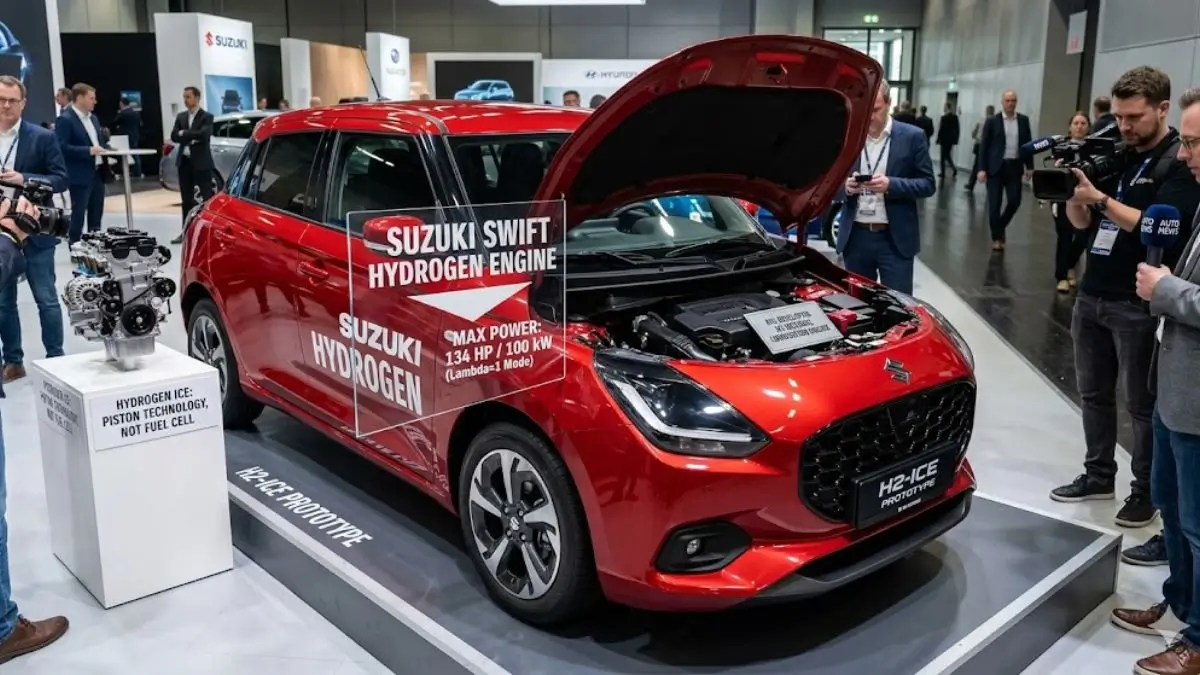
I’ve spent years tracking the automotive industry, and I’ve seen countless “future technologies” come and go. But something shifted in April 2026 at the Vienna Motor Symposium. I was there (in spirit and through the data) when Suzuki unveiled something that felt different. It wasn’t just another shiny concept car with doors that open like a spaceship. It was a Suzuki Swift. A car you recognize. A car you might even own.
But the vehicle wasn’t the Swift we’ve known for decades. This was the Suzuki Swift hydrogen engine prototype—a working, breathing vehicle that burns hydrogen directly in its cylinders.
If you are feeling a bit overwhelmed by the constant “EV or nothing” narrative, I want you to know: I hear you. The anxiety of range, the cost of batteries, and the loss of that mechanical “soul” in modern cars are real concerns for many of us. Today, I will explain why this Suzuki Swift hydrogen engine breakthrough is a significant development and how it aligns with the car you may be driving by 2028.
Understanding the “Stress Levels” of Modern Engines
Just as a doctor evaluates physical health, we need to look at the “pain points” or stress levels of automotive technology. Currently, the industry is in a state of high inflammation.
Suzuki Swift hydrogen engine (H2-ICE)
| Feature | Details (Vienna 2026 Reveal) |
| Engine Type | 1.4-Litre, 4-Cylinder (Modified Internal Combustion) |
| Development Partner | AVL (Austrian Powertrain Experts) |
| Combustion Tech | H2-ICE (Burns Hydrogen gas directly in cylinders) |
| Max Power (HP) | 134 hp (100 kW) in Lambda=1 Mode |
| Max Torque | 220 Nm |
| Emission Output | Zero $CO_2$ (Mainly Water Vapor + Trace NOx) |
| Key Innovation | Cooled EGR (Exhaust Gas Recirculation) to control heat |
| Vehicle Weight | Under 1,000 kg (Maintains “Swift” agility) |
1. The “Battery Weight” Pain
Electric Vehicles (EVs) are heavy. For a compact car like the Swift, adding 300kg of batteries ruins the “go-kart” handling we love.
2. The “Cost” Inflammation
Hydrogen fuel cells (like in the Toyota Mirai) are incredibly expensive because they require rare materials like platinum. This makes them nearly impossible to price for a budget-friendly hatchback.
3. The “Mechanical Soul” Discomfort
Many drivers (myself included) aren’t ready to give up the sound and feel of an internal combustion engine. Suzuki’s new H2-ICE (Hydrogen Internal Combustion Engine) addresses this “pain” directly by keeping the engine we know but changing the fuel it breathes.
What Engine Does a Suzuki Swift Have? (Present vs. 2026 Prototype)
If you walk into a dealership today and ask, “What engine does a Suzuki Swift have?” the salesperson will likely point you toward the 1.2-liter Z12E three-cylinder. It’s a solid, efficient engine producing 82 hp and 112 Nm of torque. It’s perfect for the city, but it’s not built for the hydrogen revolution, as it lacks the necessary technology and infrastructure to support hydrogen fuel systems.
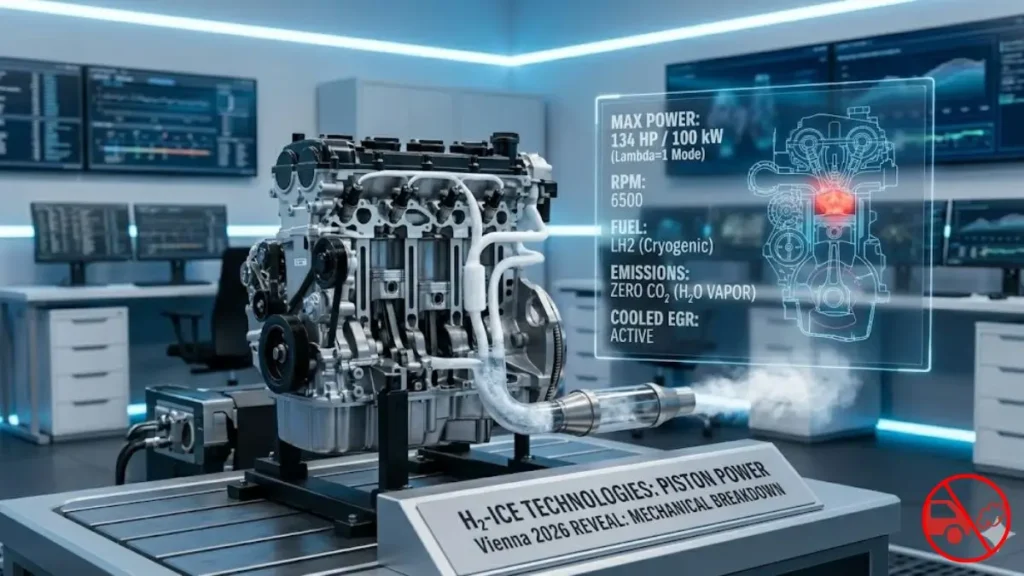
The prototype revealed in Vienna is an entirely different beast. Suzuki partnered with AVL, an Austrian powertrain specialist, to develop a modified 1.4-liter four-cylinder engine.
Key Technical Comparison
Feature Standard Swift (Z12E) Suzuki Swift hydrogen engine Prototype Type 1.2L 3-Cylinder Petrol1.4L 4-Cylinder H₂-ICE Combustion Spark Ignition (Petrol) Spark Ignition (Hydrogen)Power (HP) 82 hp Upto 134 hp Torque 112 Nm 220 Nm Emission ~100+ g/km CO₂ Zero CO₂
Performance Breakdown: Suzuki Swift Hydrogen Engine Horsepower
The most impressive part of the Vienna reveal was the power output. Suzuki isn’t just making a “green” car; they are making a speedy one. The engine operates in two distinct combustion modes to balance power and cleanliness.
- Lean Mode: The engine burns a very “thin” mix of hydrogen and air. This keeps temperatures low and reduces nitrogen oxide (NOx) emissions, though the power is slightly lower.
- Lambda=1 Mode: This is where the Suzuki Swift hydrogen engine’s horsepower truly excels. By using a “Cooled Exhaust Gas Recirculation (EGR)” system, Suzuki can push the engine to 100 kW (134 hp) and 220 Nm of torque.
For a car that weighs less than 1,000 kg (1 tonne), 134 horsepower is incredibly punchy. It’s actually more powerful than the standard petrol Swift, proving that you don’t have to sacrifice performance to save the planet.
Comparison: Current Petrol vs. Future Hydrogen(Suzuki Swift hydrogen engine)
| Specification | Standard Swift (Current) | Swift Hydrogen Prototype |
| Engine | 1.2L Z12E (3-Cylinder) | 1.4L H2-ICE (4-Cylinder) |
| Horsepower | 82 hp | 134 hp |
| Torque | 112 Nm | 220 Nm |
| Fuel Type | Petrol / Gasoline | Compressed Hydrogen Gas |
| Environment | Carbon Emissions | Zero Carbon Emissions |
Finding Your Stats: The Suzuki Swift Engine Number
Whether you are looking at a new hydrogen prototype or your current petrol model, knowing your Suzuki Swift engine number is vital for maintenance, parts, and insurance.
Step-by-Step: How to Locate Your Engine Number
- The Physical Stamp: On most Swift models, the engine number is etched into the engine block near where it meets the transmission. You may need a rag to wipe away some grime to see it clearly.
- The Registration Certificate: If you don’t want to get your hands dirty, the engine number is always listed on your RC (Registration Certificate) or “V5C” document.
- The VIN Plate: Look at the base of your windshield or the driver’s side door pillar. The engine code is often part of this larger identification system.
“When NOT to Google”: Critical Warning Signs for Your Engine
I love that you are researching new tech, but if your current car is acting up, there are times you need to stop reading and start calling a mechanic. Don’t overlook these warning signs:
- The “Oil Can” Light: If the light stays red, your engine is literally grinding itself to death. Stop immediately.
- Sweet-Smelling Steam: If your car smells like maple syrup and you see white steam from the hood, you likely have a cooling system failure.
- Metallic Clattering: If your engine sounds like a bag of marbles, you may have a timing belt or piston issue. No amount of Google searching will fix a mechanical “clank.”
- Sudden Power Loss: If your car “stutters” when you accelerate, you could have a fuel system blockage or a failing sensor.
Common Misconceptions About Hydrogen Cars
I see a lot of misinformation online regarding Suzuki Swift hydrogen engine technology. Let’s clarify the situation with some factual information:
- Misconception: “Hydrogen engines are just like EVs.”
- Correction: No! Most hydrogen cars (fuel cells) are essentially EVs that carry a “power plant” inside. This Suzuki is an internal combustion engine. It has pistons, oil, and a roar.
- Misconception: “Hydrogen is dangerous and will explode in a crash.”
- Correction: Hydrogen tanks are built from carbon fiber and are significantly tougher than your current plastic petrol tank. They are designed to vent gas safely upward in the event of a leak.
- Misconception: “It’s too expensive for a regular person.”
- Correction: Because this tech uses standard engine parts (pistons, blocks, crankshafts) rather than rare-earth battery minerals, it is much cheaper to mass-produce than a high-end EV.
Recovery and Timeline: When Can You Buy One?
The “recovery” of the automotive market depends on infrastructure. The Swift shown in Vienna is currently a proof of concept. It works—perfectly—but you can’t buy it just yet.
- 2026-2027: Expect more pilot testing and “real-world” fleet trials.
- 2028-2030: This is the “Goldilocks” zone. Countries like India (through the National Green Hydrogen Mission) are spending nearly ₹20,000 crore to build hydrogen pumps every 200km on highways. Once the pumps are established, Suzuki is prepared to commence production.
You are part of the story off Suzuki Swift hydrogen engine
We are at a crossroads in automotive history. Are you an “EV Early Adopter,” or are you waiting for something like the Suzuki Swift hydrogen engine to save the mechanical driving experience?
Submit Your Story: Have you ever had a “nightmare” experience with an aging engine? Or perhaps you’ve recently found your Suzuki Swift engine number and want to share a tip on how you did it? We want to hear from you. Your feedback helps us understand what real drivers care about.
Resorce
- Suzuki Global – Environmental Initiatives Official portal for Suzuki’s “Multi-pathway” strategy, focusing on carbon neutrality through hydrogen and biofuels.
- AVL Powertrain Engineering: The technical site for the Austrian firm that co-developed the Swift’s H2-ICE engine. It explains the mechanics of hydrogen direct injection.
- India’s National Green Hydrogen Mission: Official government page detailing the ₹19,744 crore plan to build the hydrogen pumps and infrastructure needed for cars like the Swift by 2030.
- International Energy Agency (IEA) – Hydrogen Report: For understanding the global landscape of hydrogen fuel and its role in decarbonizing transport.
- Suzuki Service Portal: For technical manuals and locating your Suzuki Swift engine number.
- Vahan NR_Services (India): To verify your engine details and registration via the government database.
FAQS
What is the mileage of 1 kg of hydrogen?
Fuel cell cars travel 60-100 km per kg in normal conditions. Toyota Mirai achieves 116 km per kg (650 km on 5.6 kg), while a Delft University prototype hit 2,488 km on 1 kg under optimal test conditions.
What is the price of 1 kg hydrogen for car?
India: ₹250-₹350 per kg today ($3-$4). Target by 2030: ₹70-₹80 per kg per Nitin Gadkari. Europe pays £16 per kg (roughly ₹1,600).
Is hydrogen better than CNG?
CNG is cheaper (₹6-₹8 per km) and available now. Hydrogen is cleaner (zero CO2, only water) but costs ₹10-₹16 per km today. Hydrogen offers 650 km range and 5-minute refuel. Pick hydrogen for emissions and range, CNG for cost and availability now.
What are 5 uses of hydrogen fuel?
Ammonia production: 55% of global hydrogen. Used in fertiliser for crops.
Oil refining: 25% of hydrogen. Removes sulfur from crude oil.
Heavy transport: Trucks and buses travel 500+ miles per fill, refuel in 15 minutes.
Steel and cement: Hydrogen burns hot enough to replace coal, cuts emissions by 7%.
Power generation: Fuel cells produce electricity for data centres, backup systems, spacecraft.
Can ice run on hydrogen?
Yes. Hydrogen burns in an ICE like petrol or diesel. Suzuki’s Vienna 2026 prototype produces 134 hp, zero CO2 emissions. Spark plugs ignite the hydrogen-air mix. Exhaust is water vapor and minimal nitrogen oxides (controlled via cooled EGR).
Mileage: 60-116 km per kg. Price today: ₹250-₹350 (target 2030: ₹70-₹80). Hydrogen beats CNG on emissions and range. ICE engines run on hydrogen—Suzuki proved it in 2026.
Disclaimer: This content is for informational purposes. The Suzuki Swift Hydrogen prototype is not yet a commercially available product. Always refer to your vehicle’s official manual for current engine maintenance.